About Industrial Heat Exchangers
Our company is presenting the best in quality Industrial Heat Exchangers, which are ideally suitable to be utilized in varied industrial plants Heaters, Coolers, etc. These kinds of heat exchangers are well engineered and fabricated from top-grade metal with developed technology that guarantees their high temperature resistance, sturdy construction, and outstanding performance. Ideal for chemical, oil, and water medium, the Industrial Heat Exchangers are highly efficient, low maintenance, durable, and come in different capacities, flow rates and specifications.
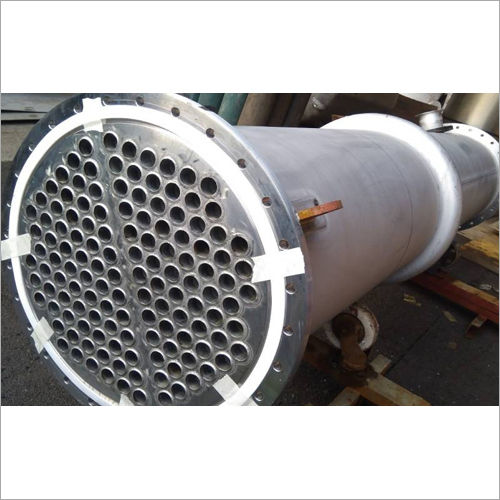
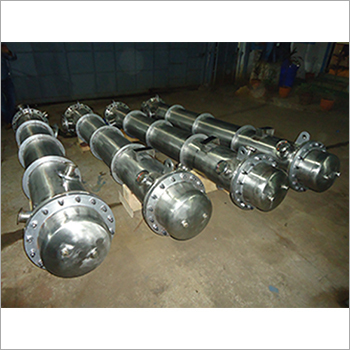
Built to Withstand Industrial DemandsConstructed from Stainless Steel 304 with an 8 mm thick shell and weighing around 1500 kg, this heat exchanger is crafted to handle aggressive fluids and rigorous industrial requirements. Its shell and tube design with flanged connections ensures easy installation and maintenance, while high corrosion resistance guarantees lasting performance.
Engineered for Efficiency and SafetyThis unit supports a substantial heat transfer area and high flow rates, facilitating efficient energy use across various systems. Adhering to ASME Section VIII design standards, it combines operational safety with reliability for seamless integration in large-scale manufacturing processes and critical utilities.
FAQs of Industrial Heat Exchangers:
Q: How does the Stainless Steel 304 construction benefit industrial heat exchanger applications?
A: Stainless Steel 304 provides outstanding corrosion resistance, which prolongs equipment life and maintains structural integrity under aggressive conditions. This makes the heat exchanger ideal for industries handling potentially corrosive fluids or requiring consistent reliability over long operational periods.
Q: What is the recommended process for installing this horizontal shell & tube heat exchanger?
A: Installation involves positioning the unit according to specified dimensions (3000 mm x 1200 mm x 1600 mm) and affixing it with flanged connections for secure sealing. It should be mounted horizontally on supportive frames to ensure optimal operation and easy access for inspection or maintenance.
Q: When should routine maintenance be performed on this heat exchanger?
A: Routine inspections are best scheduled at regular intervals, depending on the fluid types and operational load. Cleaning the tubes and checking for leaks or wear every 36 months helps maintain efficiency and extend service life.
Q: Where is this heat exchanger typically used in industrial settings?
A: Given its robust design and high resistance to corrosion, this heat exchanger is widely used in chemical processing, power plants, petrochemical industries, and food processing facilities throughout India and global export markets.
Q: What makes the shell & tube structure suitable for high liquid flow rates (up to 150 m/h)?
A: The multi-tube configuration maximizes surface area for heat transfer and allows efficient handling of large flows while minimizing pressure drops, making it ideal for systems requiring rapid temperature regulation.
Q: How does this heat exchanger ensure safety and compliance in industrial operations?
A: It adheres to ASME Section VIII standards, ensuring it meets recognized engineering and safety requirements. This rigorous compliance supports safe operation under pressures up to 16 bar and temperatures ranging from -10C to 250C.







 English
 Spanish
 French
 German
 Italian
 Chinese (Simplified)
 Japanese
 Korean
 Arabic
 Portuguese
 Send Inquiry

